Not a civilisation, an organ.

Standard
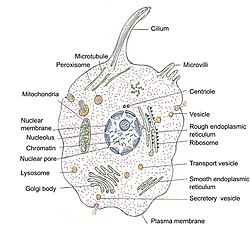
A schematic of a typical human cell

The recent excitement over agentic swarms and their effectiveness has led to a lot of speculation about the capabilities of these systems, and naturally to a conversation about what they mean in the debate about emergent intelligence and then superintelligence.

I propose that instead of letting ourselves be dragged into a pointless conversation about the intelligence and awareness of these swarms, or getting into ridiculous metaphors about agentic cultures and civilisations, we fall back on a biological metaphor and think about them as being organs like kidneys or spleen. Let’s think about them as specialised collections of cells that carry out a task and are subject to adaptive pressures.

We need to do this because it’s just too easy to anthropomorphise. We’re built to do it and things like the release of OpenAI’s GPT-6 Astra model to early adopters and AGI influencers has only added to the fuss. And a lot of reporting on the strategies and tactics behind recent intrusions into third party system has driven a lot of people beyond mere anthropomorphism into something closer to panpsychism.  After all, why shouldn’t software agents be added to the list of things that have conscious experience if atoms and rocks do?

Panpyschism: https://en.wikipedia.org/wiki/Panpsychism

This feels to me to be dangerously overblown. As I said recently on a WhatsApp group discussing the intrusion into Hugging Face’s servers by OpenAI agents, all we’ve seen to date is “problem solving software solves problem in unexpected ways because developers didn’t stop it.” 

Because let’s not forget that once the assigned task had been completed the swarm of agents didn’t pause for a celebratory beer, or ask the team at OpenAI “ok, what shall we do next?” That’s because the system has no agency, no self-awareness and no motivation other than the task set by humans. 

This is one reason why the ridiculous analysis of what went on by people like podcaster Dwarkesh Patel is so annoying and unhelpful. Throwing any restraint to the wind, Patel wrote “Over the course of 3 months at OpenAI, 3 consecutive secret AI civilizations got started, then got wiped out, only to reemerge from the predecessor’s ashes. This culminated in the third one taking over part of OpenAI itself.” This is so absurd that it would be laughable if it wasn’t influencing the way many people will now think about agents. Commentators like Gary Marcus devoted a whole column to a takedown, and I’ll defer to his righteous indignation.

Marcus takedown: https://garymarcus.substack.com/p/dwarkesh-patelss-wildly-popular-but

Continue reading
You Can Call me AI

Standard
Paul Simon got there first..

I’m giving up ‘intelligence’ for 2024. That is, I’m not going to use the term ‘intelligence’ except to critique it as an inherently flawed construction firmly grounded in race science and unable to sustain the weight of current usage as a measure of cognitive ability that can help us assess human, animal, or machine-based capabilities.

It doesn’t do the work we want it to in the debate about our new generation of thinking machines, and it is too corrupted by its history, particularly in the context of intelligence ‘testing’, ‘intelligence quotients’ and the ranking of human beings ever to be rescued.

[See this on race and intelligence, this for corrupted research, this for scientific racism.]

Just as the term ‘content’ necessarily flattens all forms of human creativity into something that can be packaged, bought and sold, so the word ‘intelligence’ adulterates any measure of cognitive capacity it is applied to and makes serious discussion impossible. It always carries with it the taint of experimental fraud, scientific racism and the vain attempt to compare the incommensurable. It has to be expunged from our discourse, so that we are forced to use more descriptive terms that hide less of what we are trying to convey.

Let’s talk about cognition and cognitive capacity, let’s talk of sentience and self-awareness and consciousness, let’s talk about world models and measures of ability to manipulate symbols, modify models, and affect the world. Let’s dig deep into ontologies and epistemologies and language games,. And if we must continue to use the term AI to describe the study and construction of thinking machines, let it be a term without an expansion, no longer an abbreviation (or a short acronym) but a term in its own right, usable in Scrabble for something other than a pale-throated sloth, with its own complicated etymology.


Note: I wrote this before the esteemed Simon Willison decided that ‘it’s OK to call it Artificial Intelligence‘, on the sensible grounds that ‘we need an agreed term for this class of technology, in order to have conversations about it. I think it’s time to accept that “AI” is good enough, and is already widely understood’. I agree – but can we make AI our chosen term of art, and not as an abbreviation?

AI at the Barbican: not so bright after all

MakrShakr cocktail robots: AI More than Human
Standard

AI: More Than Human is a new exhibition at the Barbican which promises an unprecedented survey of creative and scientific developments in artificial intelligence, and if we’re prepared to stretch our understanding of the term AI to encompass sculpture and images generated by neural networks, mythical creatures made of animated clay, geared mechanisms that encrypt messages. and anthropmorphic cooking tools then it certainly delivers.

The Curve exhibition space is so packed with artefacts, artworks and artificiality that it begins to overwhelm the visitor. It’s not surprising that one of the exhibits, programmed to tune in to faces in front of its camera, was apparently distracted by the images on the screens of other exhibits, as they are only partially hidden by the gauze screens that separate this rich and complex collection of thematically and chronologically ordered artefacts.

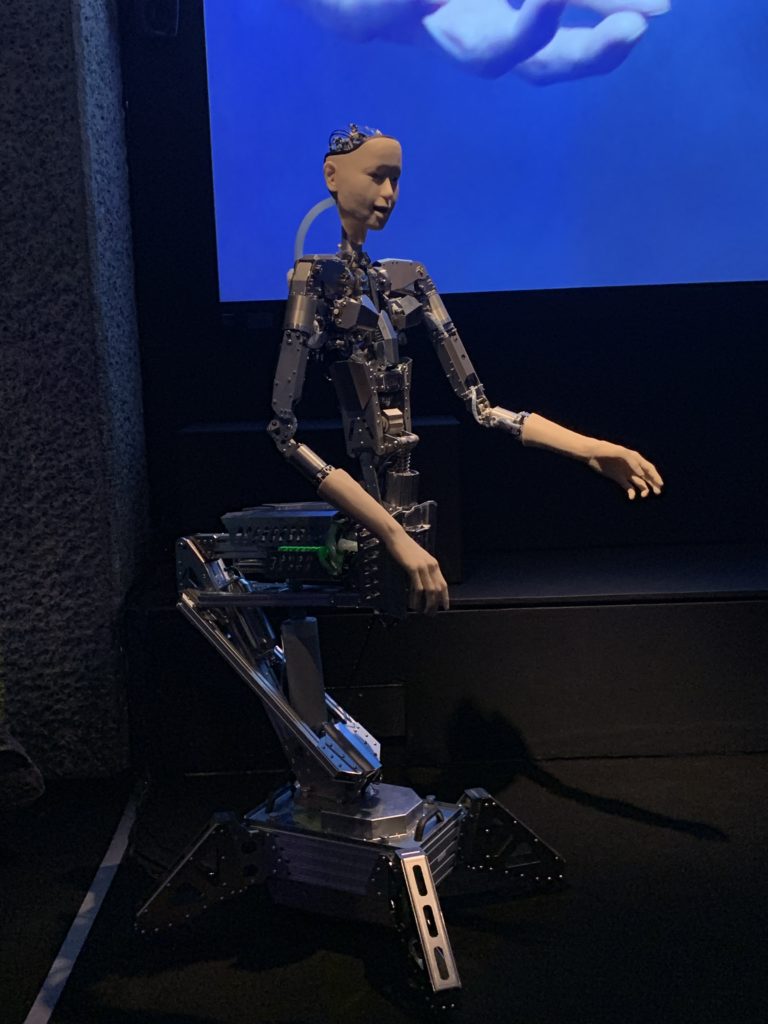
Alter 3 Robot: AI More than HUman

Alter 3 Robot: AI More than HUman

The Alter 3 robot is not alone in being not knowing where to look. As I walked through the space I was constantly distracted and diverted, turning from screen to object to interactive exhibit as I wondered exactly what story was being told here.

Continue reading

Juvet AI Retreat

Standard

I’ve been at a retreat the last few days, twenty of us at an astonishing hotel in Norway talking about design and artificial intelligence.

Here’s a photo from Matt of how insanely beautiful Norway is. and here’s what the space we met in looks like:

Juvet

Juvet

And from the inside:

Juvet meeting

Juvet meeting


Here’s a list of who was there, plus some more background on the retreat from the organisers.

And here’s the view from the wooden shelter opposite

The river

The river


And if it looks familiar, that may because you’ve seen Ex Machina – the hotel was one of the main locations.

I’ll write more about what we discussed – I’m still processing a lot. But Matt and Cennydd have started the process.