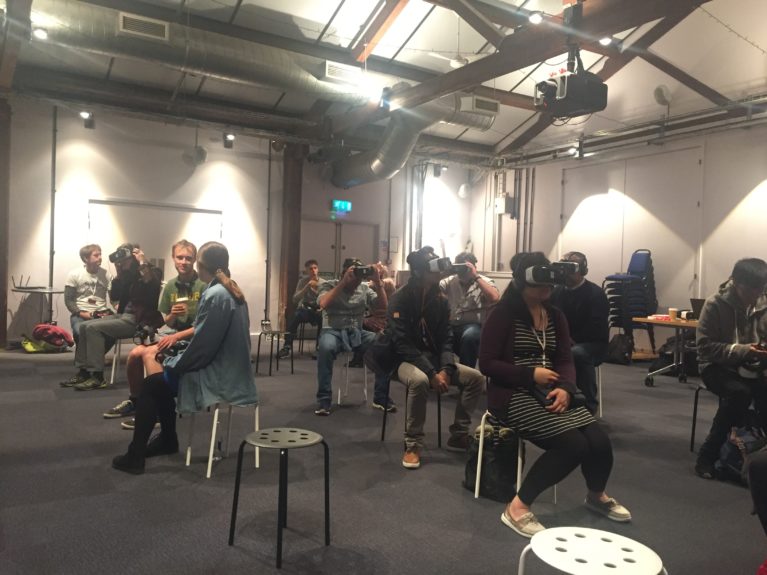
At the closing party for the 2017 Encounters Film Festival in Bristol, Catherine Allen and I discussed Second Date, Nairobi Berries and Blind Vaysha, all screened as part of the Immersive Encounters strand.
The Liminal Library: My Talk to the SCONUL Conference
StandardI gave this talk to the SCONUL Conference, in Gateshead, June 7 2017. Sconul is the Society of College, National and University Libraries.
This was what I intended to say, and roughly what I did say.
To Begin…
The cat is alive
The cat is dead
This is a time of superposition of wave states because tomorrow many of us vote – some may already have voted, like I have – in the most important UK General Election since 1945.
The act of observation will be important. And we speak before it.
So we won’t know if the cat is alive or dead until many, many boxes are opened – ballot boxes and boxes of postal votes around the country..
We do not know which world awaits us.
I will not be partisan. But my talk is written in the light of a possible future for your libraries and for the idea of a library that is predicated on enlightenment values, scholarship, humanism and humanity; an open, liberal, inclusive society that values every citizen and appreciates that we are all connected and interdependent, which embraces diversity and differences of all types – including philosophy and business model; and which is confident in itself – confident enough to be able to address the major challenges that face the biosphere as weather systems change, and that face the species as the food web shifts and comes close to collapse.
Each of you will have your own view of how that future can be delivered. I couldn’t possibly comment.
We tell ourselves stories in order to thrive
StandardTom Shakespeare’s recent BBC Radio 4 essay about stories, and the need to drive policy through stories that work, stories that are based on facts and can be used as the basis of compelling narratives, resonated with something I’ve been thinking about recently so here are my ramblings. They also owe a lot to the Dark Mountain project, which has been increasingly shaping my waking and sleeping thoughts.
Art eats politics for breakfast.
To make something (true), first make it imaginable.
Thinking Out Loud: Technology and the Arts
StandardFor the last three years I’ve held a seminar for the students on the ‘Experience’ Module of the MA Arts & Cultural Management at King’s College London, where we consider the development and likely future of digital media and how cultural managers can encompass the new possibilities in their practice.
http://www.kcl.ac.uk/study/postgraduate/taught-courses/arts-and-cultural-management-ma.aspx
The session is an attempt to look at the technology that’s out there and help students think about how you can thrive when everything seems digital, and how you can do this in a way that keeps the art and culture at the heart of your activities and planning.
I thought it might be useful to publish it here.
To Begin
If the world was simpler I’d be able to see a straight line and point you there, but there’s no hope of that. Things change in unexpected ways and the future is more like a superposition of wave states that will collapse into an experienced reality as we live through it.
So let’s begin by acknowledging that the revolution happened a while ago, while the attention of most people was elsewhere. We live in its aftermath. Let’s be inspired instead by the tropes of design fiction: “what role could we have in a world where…”
Sometimes you get it wrong… sorry, Steve
StandardIt’s ten years to the day since Steve Jobs launched the iPhone and defined the shape of the portable networked computers that now dominate our lives and act as the portal between real and virtual worlds for so many of us.
I remember it well, mostly because I didn’t see that the touchscreen was a beautifully usable interface. I even said as much on the BBC News website, back when I had a weekly column:
Having used a smartphone with a touchscreen for over a year, I can testify to the sheer irritation of having “keys” that offer no tactile feedback when you touch them and of trying to use a handheld device that forces you to stare closely at the screen whenever you’re trying to do call a number or send a text.
Touch screens work well for larger devices or fixed displays, but I’m back with a proper number pad now and loving it. I suspect that many iPhone users will do the same.
I even managed to get myself completely roasted by Fake Steve Jobs, who pointed out my arrogance and that he ‘had no idea who you were or that you went to Brasenose-upon-Oxford-in-Cambridge’ (OK, it’s not exactly a badge of honour but does show I was being read and listened to at the time).
What I failed to see at the time was the thing that is most obvious now: the iPhone wasn’t a telephone, it was a computer. And – until the advent of Echo and Google Home- we look at our computers when we use them. I was thinking about texting, not interacting.
Ah well. It’s good to remember when you got it wrong- and ask yourself every day whether you’re about to say something foolish about the next big breakthrough.
PS you can get your own copy of Reflection, which runs on a variety of ‘computers’ on the App Store. And you should.
Doctor Bill…
StandardSort of. After a ceremony today at Anglia Ruskin University’s Chelmsford campus I how have an Honorary Doctorate of Arts, which is a very fine thing. You can read the citation over on the ARU website. It’s very sweet.
I was asked to address those who were graduating today after actually doing some work and passing some exams. This is what I said (mostly).
Vice Chancellor, honoured guests and students
I’ve lived in Cambridge for over thirty-five years, and Anglia Ruskin University has played a significant part in my life. I’m old enough to remember the Cambridgeshire College of Arts and Technology and the Anglia Polytechnic days – I don’t go back quite as far as the foundation of the School of Art, but it’s not *that* far before my time!
Where Next?
StandardIn her book The New Propaganda, written in 1937/8, the British feminist and scholar Amber Wells Blanco White (read about her here… ) dissects the use of modern communications technologies to support the Fascist regimes that then existed in Europe and attempts a psychoanalytic explanation of how mass media can lead populations to support autocratic leaders like Hitler and Mussolini.
It’s a fascinating and frightening book, and was clearly used by Orwell as he designed the architectures of control used by the Party in Nineteen Eighty-Four.
Chapter four of the book looks at ‘Methods of Sustaining National Unity’ and ends thus:
“To sum up the argument of the last two chapters – the dictator who wishes to keep in his own hands all the active initiatory functions of government, and who presents himself to his people as representing the whole wisdom and power of the state, will find himself under compulsion to behave in a certain manner. This general necessity is not, of course, the only force which affects him at an particular time, nor does it operate in vacuo.
Each individual decision he makes will be the resultant of many factors. Some of these will be political and economic, some will depend on his intelligence and experience of life, others upon the personalities of those who surround him and the advice they give. There will also be an element which can only be called sheer luck. But beside these, arising from the situation in which he has placed himself, will be the necessities of which we have been speaking – the compulsion to lie, to stamp out freedom of thought and expression, to create a racial or nationalist myth of a self-adulatory type.
Whether he (or his press or his officials) restrict themselves to the truth on any given occasion will depend on upon the state of their environment at that particular moment. If they prevaricate, the particular lie they choose will depend partly on the circumstances of the moment and partly upon the nature of any preceding lies they may have told. But their need to repress and control opinion will be continuous.
The Germans who are hoping now that the regime will grow more tolerant in this respect deceive themselves. Where can it afford to loosen its control? The leadership principle – the control of the lives of the people from above down – is inherent in the acceptable of the dictatorship. All the rest follows. The regime can only grow more tolerant when it has discarded its fundamental doctrine – when it is no longer Fascist.”
Any contemporary resonance is, of course, in the mind of the reader.
Giving the BBC a purpose. Or six.
StandardThe Road from Jarrow Docks
Standard
The Open Web and Its Enemies
StandardThis lecture builds on my thinking over many years, going back to my essay Damn the Constitution in 2002[1]. It also owes much to research and thinking done for a lunchtime lecture organised by Digital Repository of Ireland in Dublin in September 2013 and a keynote talk I gave at the UKSG conference in Harrogate, April 16 2014 which was subsequently published in the UKSG journal. It’s also indebted to long conversations and arguments and debate with Wendy Hall, Nigel Shadbolt and other luminaries of Web Science.
Abstract:
In the age of electronics an open society, one in which questions can be asked, where critical thinking is not just permitted but encouraged and where investigation rather than ideology is used to seek out the truth about the world – the open society according to Karl Popper[2] – has also to be an open data society because reusable, structured data has become the main machine for doing the heavy lifting of moving knowledge around, just as books move ideas around.
The open Web is the most visible expression of that open data society, but it is increasingly undermined by the efforts of government on one side and commercial interests on the other, squeezing the public space occupied by civil society. Web science, grounded in the study of the open network, offers an opportunity both to study the impact of this shift and to propose countermeasures. In his talk Bill Thompson will argue that we can use the tools of Web science to design and build a better and more resilient Web – but that we must move quickly or there will be nothing left to save.