Fake Reality: beyond fake news

Standard
Air Quality in London, May 1 2019, Perhaps.

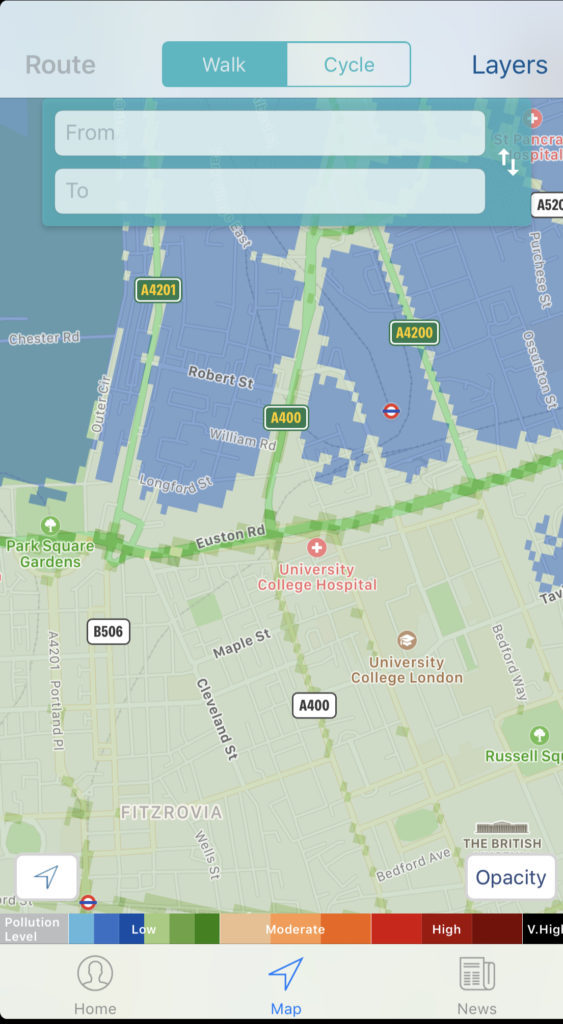
This is what the air quality in London looks like as I leave for Cambridge at the end of another day, and it’s not too bad. Except that this isn’t a picture of the air quality at all – it’s a visualiisation provided by the CityAir app on my phone screen, interpreting data from a sensor network and representing it as geodata overlaid on a map, with a colour coded scale designed to be easily interpretable because it follows a normal western convention.  

There are no numbers, but it’s green (the colour of nature!) and I feel slightly reassured that I haven’t poisoned myself too much on the bus from Savoy Place to King’s Cross.  

I could be fooling myself. It could be that there are toxins there that are simply not detected by the range of sensors available to CityAir. In fact, in the case of a chemical attack it’s highly likelly that CityAir would show all green as there would be no  cars and buses in the area because of the ensuing security alert.  

So this image isn’t ‘real’ in any sense except that it’s useful to me. However since the same could be said of my entire sensorium and the mental models I build of the world on the basis of the sense data I gather and interpret, I’m not going to dismiss it out of hand.

I’ve always had a problem with the term ‘virtual reality’ because it carries the implcation that there’s  a ‘real’ reality that it replaces.  And since I already augment my reality with the spectacles that make this screen readable I’m not sure why the augmentation provided by light field manipulating digital technologies should get sole use of the term.

Continue reading

It was twenty-five years ago today…

Imagologies
Standard

In 1994 the ICA played host to the world’s first ‘webcast’ of a live event when the Intellectuals and the New Media debate, hosted to launch Esa Saarinen and Mark Taylor’s book Imagologies(Routledge, London, 1993), was relayed online.

This is my version of what happened that evening. Others are available.

It’s April 29th1994 and I am in a van on the way to London having just liberated a few tens of thousands of pounds of expensive computing kit from the company I work for in Cambridge, in the name of art.

It’s legitimate, mostly, in that nobody will ask me why I did it as long as it’s all returned by morning and still works, and I might even get thanked for extracting the contents of the training room and moving it the Institute for Contemporary Arts if the project actually comes together and generates some interest in this ‘Internet’ thing.

Because tonight, for one night only, a group of Cambridge’s finest net pioneers – back in the day when being online at all made you a ‘pioneer’ – are going to put the ICA on the web and host what turns out to be (one of) the first events that takes place simultaneously online and offline, as we take the debate accompanying the launch of the book ‘Imagologies’ in the ICA’s Nash Room and project it into cyberspace.  

Well, if cyberspace isn’t ‘lines of non-light ranged the mind’ but a website with live updates, some audio files, and an interactive text-based MOO that lets anyone around the world with a net connection join in the debate ‘in the room’. It’s a start.

Continue reading

Karen Spärck Jones

Standard

[I wrote this obituary for The Times. The New York Times has just published its own obit in its ‘Overlooked’ series so it seems a good opportunity to disinter this one]

Professor of Computers and Information, Cambridge University, and pioneer in information retrieval and natural language processing.

Throughout her long and distinguished career Karen Spärck Jones played a leading international role in the field of information retrieval, an aspect of computer science that was rather disregarded until the arrival of the World Wide Web made effective searching a vital research priority. Today’s search engines rely on the fundamental research she carried out from the 1960’s onwards at Cambridge University.

Karen Spärck Jones was born in Huddersfield, Yorkshire, on August 26th, 1935, the daughter of chemistry lecturer Owen Jones and Ida Spärck. Her mother, a Norwegian, had worked for the government-in-exile during the Second World War.

After attending a local grammar school she came up to Girton College, Cambridge in 1953 to read history before switching to philosophy, or Moral Sciences as it was called at the time.

She graduated in 1956 and after a brief and unsatisfying spell teaching was invited to join the Cambridge Language Research Unit by its director Margaret Masterman following an introduction from Roger Needham, a friend from undergraduate days who was studying for a PhD in the Mathematical Laboratory (later the Computer Laboratory).

CLRU was working on natural language processing, looking at how computers could determine the meaning of sentences. Masterman, a former student of Wittgenstein’s, believed that meaning, not grammar, was the key to understanding languages and this view greatly influenced Spärck Jones’ work.

Spärck Jones was attempting to build a thesaurus automatically and as part of her research she transcribed the whole of Roget’s Thesaurus onto punched cards, working closely with Needham on ways to classify information automatically.  She obtained her doctorate in 1964 and her thesis, published as ‘Synonymy and Semantic Classification’, remains important even today.

Needham and Spärck Jones married in 1958 and both remained at Cambridge University throughout their careers. However while Needham rapidly obtained a tenured position and eventually became head of the Computer Lab Spärck Jones had to rely on short-term research fellowships to fund her work until she was awarded a personal professorship in 1999.

In the 1960’s she began working in the field of information retrieval, developing a technique known as ‘IDF term weighting’ which has become central to many Web-based search tools, and in 1968 she moved from CLRU to the Computer Laboratory where she remained for the rest of her life.

An active researcher and prolific writer she published nine books and over two hundred substantial papers, describing her field as ‘natural language information processing’, dealing with information in natural languages and information that is conveyed by natural language.

An inspiring teacher and supervisor, she played a full part in the academic life of the Computer Laboratory and the University, and was also a principal advisor to the Alvey research directorate which funded UK-based computing research in the 1980’s. In 1999 she organised the extensive celebrations of the 50thanniversary of the EDSAC computer in Cambridge.

She served as president of the Association for Computational Linguistics in 1994 and was elected a Fellow of the British Academy in 1995. She was a research fellow at Newnham College from 1965 to 1968, a Fellow of Darwin College from 1968 to 1980, and became a Fellow of Wolfson College in 2000, becoming an Honorary Fellow in 2002.

She formally retired from the Computer Laboratory in 2002 but this did not diminish her commitment and she continued to work full time in  the Laboratory.  Throughout her career she tried to bring more women into computing, arguing that it was too important a discipline to be left to men.

Roger Needham, who had left the Computer Laboratory to become director of Microsoft Research Cambridge, based in the building next door, died in 2003.

Spärck Jones received many honours during her long and distinguished career, including the Association for Computational Linguistics Lifetime Achievement Award and the Institute for Information Scientists research award.

In 2007 she was awarded the Lovelace Medal by the British Computer Society, the first woman to receive it, and the Allan Newell Award and Athena Lectureship by the American Association for Computing Machinery. With typical foresight she recorded an acceptance lecture before her final illness made it impossible.

Outside computing and linguistics her interests ranged widely. She and Needham built their own house at Coton, just outside Cambridge. She was also an enthusiastic and capable sailor and the couple sailed an 1872-vintage Itchen Ferry Cutter on the east coast.

She had no children.

Karen Ida Boalth Spärck Jones, pioneer in information retrieval and natural language processing, was born on August 26, 1935. She died on April 4, 2007, aged 71.


The arts, politics, and technology

panel at Citizen of Nowhere
Standard

(pic of the panel courtesy of Emma Hughes)

This morning I took part in a fascinating panel discussion about the intersections of art and technology – with a focus on theatre because it was hosted by the National Theatre of Scotland as part of this year’s Neon Festival in Dundee ⁦@NTSonline⁩  ⁦@weareneon⁩.

A couple of dozen noble people came out on a chilly saturday morning to hear us think out loud about our practice, our concerns, and our dreams, and it was a pleasure to be there with Lizzie Hodgson @ThinkNat Mark Stevenson @Optimistontour Emma Hughes @LiminaImmersive Ruth Catlow @furtherfield and Annie Dorsen @AnnieDorsen, all chaired by NTS Digital Thinker in Residence Harry Wilson @theharry_wilson.

We each had five minutes to introduce our theme, and this is what I said in my attempt to keep the conversation lively. (yes, I’m quoting the Big Chill.. you can’t stop me)

My notes for speaking

My notes for speaking

Continue reading

Can Truth Prevail Online?

Standard

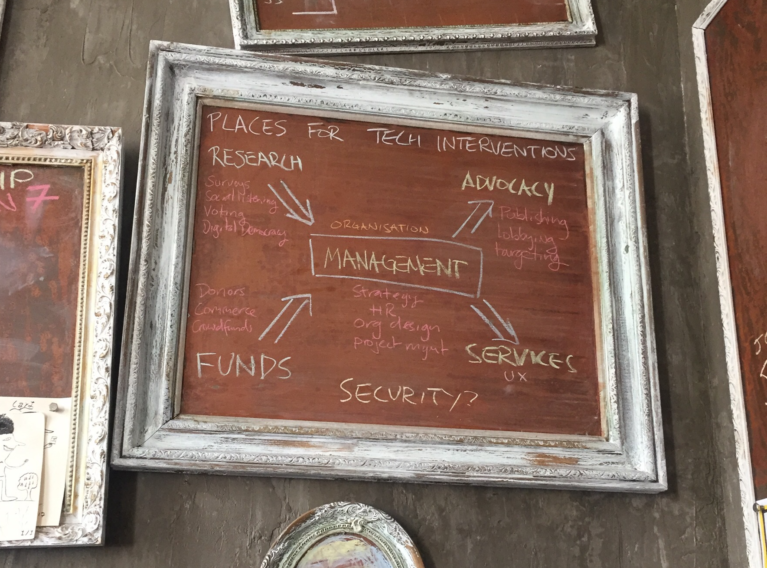
(image: noticeboard at Newspeak House)

We have been anticipating the internet’s impact on the political process for over two decades now, with talk of ‘the first internet election’ going back to at least 1997 in the UK, a time when political parties and candidates built their first websites and started emailing supporters in the hope of influencing their voting.

We have come a long way from the first online MP’s surgery, which I ran for Cambridge MP Anne Campbell in 1996, or the mailing list and website archive that constituted the Nexus ‘online think tank’, and it’s clear that we now have what we asked for: it is impossible to disentangle the political process from the network, and all politics seems to have an online dimension, even in countries where net access is limited.

However the consequences are clearly not those that early advocates of networked politics might have hoped for.  Far from the network ushering in a new age of deliberative democracy fuelled by active and engaged citizens, online activism has become a tool for those who would undo the Enlightenment’s gains and push pack many of the social changes that have characterised open societies.

Continue reading

Public Service: beyond the Open Internet

Standard

Anyone who has followed my writing, talks and broadcasting over the last two decades will know that I have a very consistent view of the ways in which we need to manage the Internet (I’ll grant myself the privilege of using an upper-case I to talk about the network I’ve been living and working with since the mid-80’s – it remains a singular thing to me) in order to make it work for people and society.

From my pamphlet on the mutualism of the Internet for the Cooperative Party in 2000 (https://medium.com/@billt/e-mutualism-or-the-tragedy-of-the-dot-commons-489bfbd965ea), through my inflammatory essay for The Register in August 2002 (https://www.theregister.co.uk/2002/08/09/damn_the_constitution_europe_must/) , and my Cybersalon Christmas Lecture at the ICA later that year (https://medium.com/@billt/in-december-2002-i-gave-the-cybersalon-new-media-knowledge-christmas-lecture-at-the-institute-of-97f7510e4eb8), and on through many columns, talks and extemporised rants over the years, I’ve argued that we need to create rules that allow us to deliver a network that genuinely supports free expression, and that this requires engineering effort, because a dumb, unregulable, end-to-end service that simply delivers bits does not properly serve the public interest.

I’ve always argued that we don’t get free speech by having no rules online, but by building a network that can have rules applied and then winning the political arguments for laws and regulations which guarantee that free speech, within the bounds of a specific group, country or culture, and according to their agreed standards.

Continue reading

Reality Ain’t What It Used To Be

Bill in sunglasses, with Blade Runner imagery photoshopped in the lenses
Standard

In his remarkable essay ‘The Last Days of Reality’ [https://meanjin.com.au/essays/the-last-days-of-reality/] Mark Pesce surveys the ways Facebook exerts its influence on our lives, reviews the impact of machine learning technologies on the analysis of the personal data we all leak into the datasphere, and channels his inner Huxley to conclude that:

the future of power looks like an endless series of amusing cat videos, a universe cleverly edited by profiling, machine learning, targeting and augmented reality, fashioning a particular world view in which we will all comfortably rest”. Forget the boot, stamping on the face of the opppressed – Facebook will bring our slippers and pipes so we can sit comfortably by the fire, with no desire the challenge the authoritarian orthodoxies of our rulers.

Continue reading

Fixing a Wheelchair on Christmas Eve

Standard

[Me and my mum, off to a Royal Garden Party in about 1999]

It’s Christmas Eve and I’m spending it in Casole d’Elsa, a small town not too from Florence and remembering a December thirty years ago when I brought my mum to Florence for Christmas as she’d always wanted to visit but her limited mobility – she needed a wheelchair for all but the shortest trip – had made it harder for her to get around.

It occurs to me only now that she was the age I am now – 57 – but in my memories of the time she is older and more infirm. Her choices in life had been so severely limited that it is perhaps unsurprising I see her that way – by her late fifties she had few opportunities open to her.

So we went to Florence for a week on a package holiday, staying in a small hotel near Santa Maria Novella and enjoying the city, the culture and the people. We managed to get up the stairs to the Uffizi, and I wheeled her along the Arno and across the Ponte Vecchio.

Continue reading

Buying a ticket with a Network Railcard at 0945…

Standard

This is of minority interest, but if I put it here it becomes findable…

There is a bank of ticket machines at Cambridge rail station and they will sell you tickets. Some tickets. If you have a Network Railcard (valid after 1000) and you buy a ticket to London at 0945 the machine lets you select your ticket and click Add Railcard but it won’t let you select Network Railcard because it’s ‘not valid at this time’.   Except it will be valid when you get on the train, which you are about to do.  Someone, somewhere, has hard coded this logic and it’s annoying especially if you’ve got to the station early to avoid the queue.

However today Maria, who is a station marshall, showed me a workaround.  If you select ‘travel in future’ you can select TODAY as the future day you’re going to travel on and give it a train time AFTER 1000. Then when you’ve selected your ticket it will offer the Network Railcard option.

I hope this helps. It helped me.

Juvet AI Retreat

Standard

I’ve been at a retreat the last few days, twenty of us at an astonishing hotel in Norway talking about design and artificial intelligence.

Here’s a photo from Matt of how insanely beautiful Norway is. and here’s what the space we met in looks like:

Juvet

Juvet

And from the inside:

Juvet meeting

Juvet meeting


Here’s a list of who was there, plus some more background on the retreat from the organisers.

And here’s the view from the wooden shelter opposite

The river

The river


And if it looks familiar, that may because you’ve seen Ex Machina – the hotel was one of the main locations.

I’ll write more about what we discussed – I’m still processing a lot. But Matt and Cennydd have started the process.