
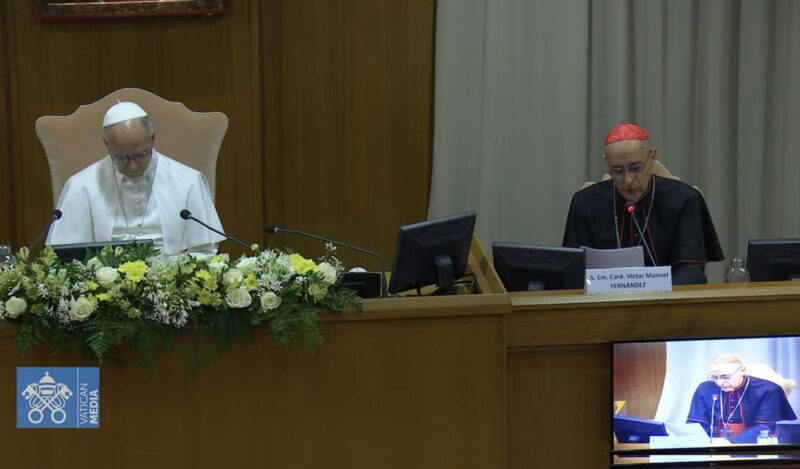
The Catholic Church is actively responding to the challenges posed by artificial intelligence through various teachings, but the main event is Pope Leo’s new Encyclical, Magnifica Humanitas. It’s the product of the wonderfully named Interdicasterial Commission on Artificial Intelligence which convened in response to a rescript signed by Cardinal Michael Czerny, Prefect of the Dicastery for Promoting Integral Human Development
This is a video from the Vatican to promote it. It is quite astonishing.
The document was signed by the Pope on May 10 and published on May 25 as the current Pope’s first Encyclical, and it’s a biggie, at 42,000 words. It addresses the issue of “safeguarding the human person in the time of artificial intelligence” and it doesn’t pull any punches, beginning by telling us that “humanity, created by God in all its grandeur, is today facing a pivotal choice: either to construct a new Tower of Babel or to build the city in which God and humanity dwell together.” That seems fairly binary and we reckon that AI isn’t the path to the second option
You might think the Tower of Babel was a good thing because it was about a time when all humans spoke one language and pursued the ambitious project of building a tower that would touch Heaven, until God breaks up the party, divides us by language, and scatters us across the world. As the Encyclical puts it “Fearing being scattered across the earth, they sought to guarantee stability and power for themselves, and above all to “make a name” for themselves. It was an impressive feat: a single language, a single technology, a single direction.
However, the project concealed a profound danger. It was a project conceived without reference to God, supported by a uniformity that eliminated diversity and that chose homogenization over communion. When a city is built on pride and the claim to self-sufficiency, communication breaks down, languages are confused and people no longer understand each other. The result is not unity, but dispersion. Babel thus reveals the limits of any effort that, however grandiose, arises from self-affirmation, sacrifices human dignity for efficiency and aspires to reach heaven without God’s blessing,”
Yes indeed, for Leo and his Cardinals AGI is an attempt to construct another Tower of Babel, a hubristic human project undertaken without without reference to God, that offers homeogeneity over communion and is built on pride.
Trying to find a good argument against this, is a bi of a struggle. And it is no accident that Leo XIV signed the encyclical on May 15, the 135th anniversary of the promulgation of Pope Leo XIII’s 1891 Rerum novarum, which marked radical change in Catholic doctrine by addressing the social and economic issues arising from the Industrial Revolution. The parallels between the degrading effects of the first industrial revolution and the dangers of the fourth hardly need pointing out. Rerum novarum stressed the rights and duties of both labour and capital, advocating for the dignity of workers and the importance of fair wages and working conditions, topics which MorseLs readers may be familiar with in the context of AI. You can see where the Leos are coming from.
If you want to get the heart of the whole document, try para 233:
“For this reason, as a believer among believers, I invite everyone to contemplate, in the face of the Son of God, the grandeur of humanity that shines a light also on the era of AI. In Christ, we are called to cooperate in the work of creation, rather than be disinterested observers of technological processes that limit our freedom and responsibility. The dignity inscribed in each of us by the Holy Spirit can also be seen in our capacity to reflect critically, choose and love freely, and form authentic relationships. No computational system, however sophisticated, can create a heart that gives itself, or a conscience that discerns good from evil. Even when machines excel in efficiency, a human face that asks to be gazed upon remains the center of our history.”
Got that? Now defend OpenAI’s business model.
It feels somewhat.. ironic (in the real sense of the word not the Alanis Morissette one) that the Holy Roman Catholic Church seems to be the most significant large organisation to speak out against the potential dangers both of AI and the US government’s slide into authoritarianism and repudiation of international law. And the Pope may not have many divisions but he does have over a billion believers.
Read the Vatican News report and BBC News coverage
Press release about the main event
Read all 42,000 words here. Anyone who puts it into ChatGPT is excommunicated.
Anthropomorphism?
The formal launch took place in the Vatican’s Synod Hall, with the Pope, Cardinal Víctor Manuel Fernández, Cardinal Michael Czerny, S.J., Professor Anna Rowlands, Chris Olah, co-founder of Anthropic, and Professor Leocadie Lushombo joining him.
Olah’s remarks are worth watching as they felt like the authentic expression of someone who is grappling with serious concerns and not a corporate pitch that has been lawyered into meaningessness. For example he said “no matter how sincerely any of us intend to do the right thing, and I believe many of us do, we will always be influenced by those incentives. That is why, if we want this technology to go well, it is enormously important that there be people outside those incentives, people who care about things going well, who are paying close attention, who are willing to say hard things and insist on safety, who are willing to be our earnest, thoughtful critics. It is through dialogue and mutual effort, through the push and pull, that humanity will achieve great things. That is what I see in Magnificat Humanitas. And it is why I am grateful to His Holiness and to the Church for taking up this work of discernment” and it felt like he meant it.
And he went further, explicitly saying that we can’t leave this to the tech bros (and they are bros): “some might believe the matters of AI are best handled by computer scientists like myself. They are mistaken. The questions raised by AI are bigger than the AI research community, not just in their implications, but also in their nature. AI systems are not engineered the way a bridge or an airplane is engineered. We understand an airplane because we designed every part of it. And we understand the physics that act on it. AI models are not like that.”
In the end, he acknowledged his own weakness in this debate, saying “these are not questions a lab can answer. But they are questions traditions like yours have carried for millennia. And we need you to keep carrying them into this new moment in history.” And he called for help: “today is just the beginning, the start of a long collaboration between those of us who are building this and those who can see what we, from the inside, cannot.”
This is all good, but as an atheist I’d like to note that you can’t leave this to the faith based communities either and it needs all people of good will to step up and engage, including those of us of a rationalist and humanist bent. We have some good tools to hand – they are called ‘science’, especially the social sciences – and although the track record is chequered we should at least engage.
It is also worth noting that Olah was the only one on the platform not to cross himself at the Pope’s blessing at the end, which shows both that he’s not a practicing Catholic and also not a hypocrite.
PS massively obscure reference here and prizes to anyone who has heard of either of them but I was taught philosophy by Elizabeth Anscombe and Peter Geach, two of the most important analytical philosophers of the twentieth century and both devout Catholics who would never have used their insights to probe doctrine.
Anthropic at the Vatican report
About Chris Olah and his remarks at the event
The Catholic Mysteries. Stay away.
Thanks to the wonderful Laura Ellis for insights and assistance with this. Any heresy is entirely my responsibility